The Mental Health Recovery Star helps you track your progress across ten key life areas like mental health, self-care, and social connections. You’ll work collaboratively with mental health professionals to assess where you are on the “Ladder of Change,” from feeling stuck to achieving self-reliance. Through regular three-month assessments, you’ll set personalized goals and measure improvements in each domain. This evidence-based framework offers a structured pathway to understanding your complete recovery journey.
Understanding the Recovery Star Framework

The Recovery Star Framework represents a groundbreaking approach to mental health treatment, built upon the foundational Outcomes Star and refined specifically for adult mental health applications. This framework operates through the Ladder of Change theory, which maps progress across five distinct stages: Stuck, Accepting Help, Believing, Learning, and Self-Reliance.
You’ll find that recovery principles are deeply embedded in the framework’s structure, emphasizing positive growth potential rather than just symptom reduction. The system’s strength lies in its collaborative nature, with user involvement at every stage of the process. The tool comprehensively assesses ten key domains including physical health, living skills, social networks, work, relationships, and addictive behavior. It’s designed to provide a visual representation of your recovery journey while incorporating holistic care and strengths-based approaches. This evidence-based tool enables practitioners and service users to work together in identifying goals, tracking progress, and making informed decisions about treatment directions.
Key Domains and Assessment Areas
The Recovery Star framework measures your progress across five essential domains: mental health management, self-care, living skills, social connections, and personal identity. You’ll find that each domain operates on a clear progression ladder, moving from dependency toward independence and self-reliance. These interconnected areas provide a thorough view of your recovery journey, allowing clinicians to assess your growth and target specific interventions where needed. The tool focuses on delivering outcomes that are important to the consumer, as recovery-oriented service provisions emphasize consumer-centered care. The assessment process is quick and easy, making it an efficient tool for both staff and service users to track progress together. The Recovery Star was co-developed with clients to ensure it accurately reflects the real experiences and needs of mental health service users.
Core Recovery Domains Explained
Recovery domains within Mental Health Recovery Star encompass five core areas that form the foundation of thorough treatment assessment and progress monitoring. When managing mental health, you’ll focus on implementing recovery strategies and self monitoring techniques while engaging with your treatment plan. Daily functioning relies heavily on maintaining physical health and self-care routines, from proper nutrition to quality sleep.
Living skills assessment evaluates your ability to handle practical tasks independently, while social network evaluation measures your community engagement and support systems. The domain of identity and self-esteem examines your self-concept, confidence, and hope for recovery. Through these interconnected areas, you’ll work collaboratively with practitioners to set achievable goals, develop coping mechanisms, and build a sustainable path toward improved mental well-being.
Measuring Progress Through Stages
Through systematic assessment of the Ladder of Change scale, practitioners and service users collaboratively measure progress across five distinct stages ranging from “Stuck” (1-2) to “Self-Reliance” (9-10).
You’ll find ten core domains that serve as essential progress indicators: managing mental health, self-care, living skills, social networks, work, relationships, addictive behavior, responsibilities, identity and self-esteem, and trust and hope. Each domain receives an individual score, enabling precise tracking of your recovery benchmarks across multiple dimensions of well-being.
This thorough approach allows for targeted goal-setting based on your specific needs and priorities. The domains align with evidence-based recovery outcomes, and you can focus on areas most relevant to your journey. Regular assessments, typically conducted every three months, guarantee consistent monitoring of your advancement through each stage.
Impact Across Life Areas
Mental health recovery encompasses five interconnected life domains that form the foundation for thorough assessment and intervention. Through impact assessment across these areas, you’ll track progress in managing symptoms, developing self-care routines, building living skills, strengthening social connections, and fostering personal identity.
The Recovery Star evaluates your life balance by examining how you’re managing daily wellness activities, maintaining independent living arrangements, and engaging with support networks. Self-rated measures help promote recovery-oriented approaches to mental health care. You’ll receive feedback on your ability to implement coping strategies, handle practical tasks, and nurture meaningful relationships. The tool measures your growing sense of self-worth, trust in others, and hope for the future. This extensive approach guarantees that treatment addresses not just clinical symptoms, but your overall capacity for autonomous living and community integration.
The Five Stages of Change
The Recovery Star’s five stages outline your progression from feeling stuck to achieving self-reliance in mental health treatment. You’ll experience measurable shifts through accepting help, believing in change, and learning new skills, with each stage corresponding to specific score ranges on the assessment scale. Your advancement through these stages provides clinical evidence of personal growth and treatment effectiveness, allowing both you and your healthcare providers to track meaningful milestones in your recovery journey. The assessment’s structured approach was developed through Triangle Consulting’s collaboration with mental health professionals to ensure comprehensive recovery planning.
Understanding Recovery Progression
Recovery progression follows a well-established pattern of five distinct stages that individuals typically experience when addressing mental health challenges. Each stage represents a specific mindset and level of readiness for change, from precontemplation’s initial resistance to maintenance‘s sustained stability.
You’ll notice your journey through these recovery stages often begins with denial or unawareness, moving into a period of contemplation where you’re weighing the pros and cons of change. During this early phase, many individuals experience intense fear and guilt while defending their current behaviors. The time spent in each stage can vary significantly, as progression is unique to every person. As personal insights develop, you’ll enter preparation, where concrete plans take shape. The action stage follows with direct engagement in treatment and new coping strategies. Finally, in maintenance, you’ll find yourself actively managing your mental health with increased confidence and established support systems, though remaining vigilant against potential setbacks.
Navigating Personal Growth
Understanding personal growth through the five stages of change provides an essential framework for maneuvering your mental health journey. As you progress through precontemplation to maintenance, your personal reflections and growth strategies evolve considerably. You’ll experience distinct shifts in awareness, commitment, and action-oriented behaviors. While individuals in early stages may be high-functioning substance users, their need for change often becomes apparent as consequences emerge over time. The process encourages individuals to move through recovery at their own pace while building self-awareness through education and support.
| Stage | Internal State | Growth Strategies |
|---|---|---|
| Precontemplation | Resistance | Educational engagement |
| Contemplation | Ambivalence | Self-reflection exercises |
| Preparation | Readiness | Resource gathering |
When you’re actively working through these stages, it’s vital to recognize that change isn’t linear. You might move back and forth between stages as you develop new coping mechanisms and build resilience. Your progress depends on consistent engagement with treatment approaches, support networks, and professional guidance while maintaining focus on your recovery goals.
Measuring Treatment Milestones
Measuring your progress through treatment milestones provides clear benchmarks for mental health recovery. The journey typically begins in precontemplation, where you’re unaware or resistant to change, then moves into contemplation as you start recognizing the need for help. During preparation, you’ll engage in milestone tracking by researching options and setting concrete goals.
The action stage marks significant progress indicators as you implement new behaviors and actively participate in treatment. In maintenance, you’ll focus on sustaining positive changes while using the Recovery Star framework to visualize achievements across different life areas. Remember that movement through these stages isn’t always linear – you may revisit previous stages as circumstances change. Regular progress monitoring helps you and your treatment team adjust strategies and celebrate improvements throughout your recovery journey.
Collaborative Goal Setting Process
Through its collaborative framework, the goal-setting process enables mental health professionals and service users to jointly identify, develop, and pursue recovery objectives across ten key life domains. This shared approach guarantees goal alignment while fostering empowerment and sustained engagement in treatment. Research shows that strong working alliance consistently leads to improved recovery outcomes in mental health services. The approach aims to help individuals live well with their mental health conditions while focusing on recovery.
| Process Component | Staff Role | Service User Role |
|---|---|---|
| Initial Planning | Facilitate discussion | Express preferences |
| Goal Development | Support realistic targets | Define aspirations |
| Progress Review | Monitor and document | Provide feedback |
You’ll work with your mental health professional using a common language that supports mutual understanding. The Recovery Star’s ladder of change model helps track your journey from dependence to self-reliance. This collaborative approach strengthens the working alliance between you and your care team, leading to shared objectives that reflect your personal values and recovery priorities.
Measuring Progress and Outcomes

The Mental Health Recovery Star enables precise measurement of therapeutic outcomes through its robust psychometric properties and standardized scoring methodology. You’ll find its ten core domains rated on a 10-point scale, directly mapping to recovery progression stages and demonstrating strong internal consistency through high Cronbach’s alpha coefficients. The tool’s collaborative nature has been widely recognized by clinicians for enhancing care planning effectiveness. The system is available in multiple languages, making it accessible to diverse populations.
For effective outcome tracking, you’ll need to conduct reassessments every three months, with at least 42 days between assessment intervals. The tool’s five-stage ‘ladder of change’ scoring system links directly to measurable clinical progress. You can record both quantitative scores and narrative data, while visual star charts illustrate progress over time. Studies consistently show statistically significant increases in total and domain-specific scores, with large effect sizes post-intervention, confirming the tool’s effectiveness in measuring therapeutic change.
Benefits for Service Users and Staff
While implementing the Mental Health Recovery Star, both service users and staff experience significant mutual benefits that enhance therapeutic outcomes. Through user empowerment, you’ll gain increased self-reliance and ownership of your recovery journey, supported by visual mapping that helps track your progress across key domains. The tool enables you to express your needs more effectively and set personalized goals. The Recovery Star effectively measures participant outcomes, with 35% showing improvement in mental health scores.
Staff collaboration becomes more structured and meaningful, as the Recovery Star provides a systematic framework for therapeutic conversations. You’ll work together to establish shared understanding and priorities, while staff develop enhanced empathy and professional skills. The tool’s documented success in improving social connections (45% improvement in social connection scores) and maintaining relationships demonstrates its effectiveness in promoting both individual recovery and professional development.
Practical Implementation in Care Settings
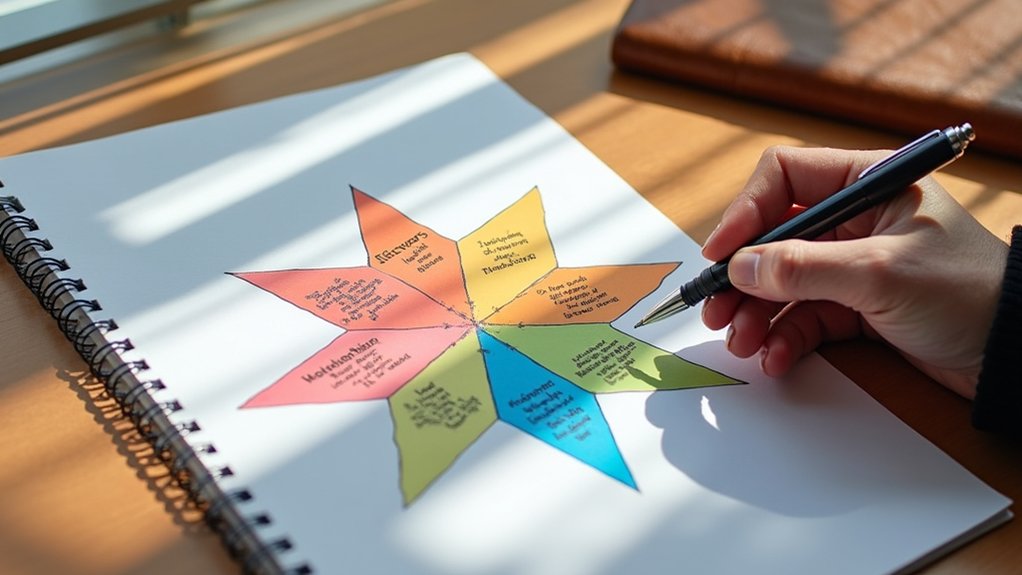
Successfully implementing the Mental Health Recovery Star requires a structured collaborative assessment process between clinicians and service users across ten essential life domains. You’ll need to guarantee proper staff engagement through thorough training and organizational support while adapting the tool to your specific care environment. The tool’s flexibility allows for adaptation across various mental health settings, from inpatient to community care. You’ll find that effective implementation relies on incremental steps, ongoing evaluation, and addressing potential barriers through change management strategies. Regular monitoring of outcomes helps validate the tool’s effectiveness and supports quality improvement initiatives. Evidence shows the tool effectively measures improvements in key areas like symptom management and social connection when used within a recovery-oriented model.
| Implementation Phase | Key Activities | Success Factors |
|---|---|---|
| Initial Setup | Staff training | Leadership support |
| Assessment Process | Domain scoring | Client collaboration |
| Care Planning | Goal setting | Shared decision-making |
| Progress Monitoring | Regular reviews | Data tracking |
| Service Adaptation | Environment fit | Flexible delivery |
Research Support and Clinical Evidence
Research evidence strongly supports the Mental Health Recovery Star‘s effectiveness as a validated clinical assessment tool. Studies demonstrate high internal consistency and a robust two-factor structure, confirming its reliability in measuring recovery-oriented constructs. You’ll find the tool shows responsiveness to change, with measurable improvements documented over 5-9 month periods.
The Star’s research validity is strengthened by its demonstrated effectiveness in outcome measurement across diverse clinical settings. You can track client progress through quantifiable data showing improvements in social networks and mental health management. Studies indicate that 35% of clients show improved scores on second review, while 45% maintain stability. While some research gaps exist regarding retest reliability and external validity, the tool’s clinical utility is well-established through both service user and clinician endorsement.
Frequently Asked Questions
How Long Does a Typical Recovery Star Assessment Session Take?
Your Recovery Star assessment session typically takes 30-60 minutes to complete. The session duration varies based on your engagement level and the depth of discussion across the ten recovery domains. When you’re participating in follow-up assessments, which usually occur at 6-week to 3-month intervals, these sessions may be shorter as they focus primarily on changes since your last review. Most service users find this timing suitable for meaningful reflection and goal-setting.
Can the Recovery Star Be Used With Patients Who Don’t Speak English?
Yes, you can use the Recovery Star with non-English speaking patients through proper cultural adaptation and language support. You’ll need professionally translated materials and either bilingual practitioners or trained interpreters to facilitate meaningful engagement. It’s crucial to adapt not just the words, but also cultural references and metaphors for your target population. Visual aids and translated Star Charts can help bridge communication gaps during assessment sessions.
What Happens if a Patient’s Scores Decrease Between Assessment Periods?
If your scores decrease, it’s important to understand this doesn’t necessarily indicate treatment failure. During score interpretation, your care team will explore potential causes, including life changes, increased self-awareness, or emerging challenges. Treatment adjustments may follow, such as revising your care plan or increasing support levels. Your healthcare provider will discuss the changes with you openly, using this opportunity to guarantee your treatment remains aligned with your needs and recovery goals.
Is There a Minimum Time Interval Required Between Recovery Star Assessments?
No, there isn’t a mandatory minimum time interval between Recovery Star assessments. While assessment frequency typically follows a six-month cycle, you can adjust the timing based on your service’s intensity and client needs. To maintain evaluation consistency, you’ll want to guarantee enough time has passed for measurable change. It’s best practice to establish rapport before the initial assessment and document your organization’s chosen intervals in your service policies.
Can Family Members or Caregivers Participate in Recovery Star Sessions?
Yes, you can include family members and caregivers in Recovery Star sessions with your consent. Family involvement is strongly supported by evidence showing 35-45% improvements in mental health outcomes when caregivers participate. You’ll benefit from enhanced treatment adherence, better social connections, and more consistent progress through recovery stages. Caregiver support also helps bridge gaps in your care routine and provides valuable insights during goal-setting and review sessions.